FAQ'S
Here you’ll find answers to the most commonly asked lawn & turf care questions. Can’t find what you need? Give us a call on 01905 840 279
Deliveries
This could be a problem. If you consider your access is in anyway restricted please contact our office to seek advice on deliveries.
Deliveries of turf, topsoil and bark are available Tuesday through to Mid-day Saturday. You can also choose an AM or PM delivery. The options available and any additional costs can be seen through the ordering process and before final check out on our Online store. All other items, unless ordered with turf/ topsoil/ bark will be sent as standard Royal Mail deliveries.
Not as a general rule, as delivery Lorries do not have the ability to lift over obstacles, but we may be able to provide forklift off loading or other means by prior arrangement. Please contact our office.
It is always advisable to be on hand, but should you not be available usually the turf is left as a kerb side delivery.
To reduce our environmental impact, we reuse all returned pallets. You are welcome to return pallets should you wish to by your own arrangement.
We do deliver to all of Mainland Britain; with the exception of the Highlands of Scotland and to some off shore islands, but please contact our office if you are unsure.
Our standard quoted price includes cost of delivery for a chosen day. If you opt for a Saturday or timed delivery any additional charges will be made clear before checkout is completed.
We would expect you to receive your turf on the day you have requested if you have requested an AM or PM delivery these are normally reliable but traffic conditions can sometimes play a factor.
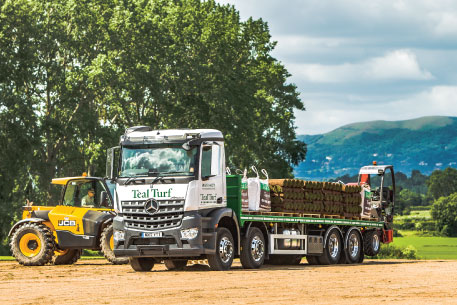
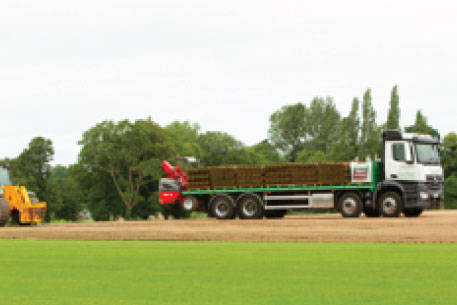
A kerbside delivery is operated to comply with Regulations. Often the turf is delivered on a large rigid flatbed lorry and off loaded with forklift truck. Further details can be found in our Shopping Help page.
Lawn Advice
Generally at the time of delivery your cultivated turf will be free from broadleaf weeds and fungal diseases and of good colour. We use the best seed mixtures available to us to produce the best looking turf.
Teal Turf strive to minimise weed grasses in our turf however we cannot eliminate them all. Some rolls may have a higher content than others.
It is very difficult to selectively kill one grass species growing in a mixture with other types of grasses. It is not possible for turfgrowers to use chemical control to eliminate weed grasses from cultivated turf. As herbicides are not available cultural methods which are less reliable have to be used.
Annual meadow grass (also commonly known by its Latin name of Poa annua) is the most commonly found weed grass in rolls of cultivated turf. Annual meadow grass (AMG) is one of the most widespread grasses in the world and most established lawns contain some annual meadow grass, but it usually blends in well with the other grasses. AMG may become more evident in lawns at different times of the season and growing conditions.
As Annual meadow grass is mostly an annual plant and the life span of the plant can be less than a year. So good management of your new turf as with all lawns minimises the future appearance of AMG in your lawn.
We harvest turf throughout the year with the only exception being when the ground is frozen. This usually only equates to a few days a year when we are unable to harvest turf.
During colder months grass growth virtually stops. As a result no nutrients are being absorbed by the grass plants making your lawn more vulnerable to a range of conditions and fungal diseases. All of these diseases occur naturally and will lead to patchiness within a lawn. Recovery will not be seen until the next spring growing season.
If your lawn tends to die off during the winter there may be an underlying problem such as water logging, poor soil structure, compacted soils, heavy surrounding vegetation or a lack of quality lawn fertiliser. All of these cause a lawn to be under stress and more susceptible to disease. Consequently a good all year round maintenance regime is all important. Read more about Lawn Pests and Diseases.
One of the most important lawn maintenance actions is to apply a spring application of lawn fertiliser. Often your lawn will grow away from any winter die back.
Please refer to our ‘How to calculate the area of your lawn’ page.
See our article Turf Installation Guide.
In spring/summer months it is important to lay your turf on the day of delivery. If you cannot achieve this the turf needs to be unrolled in a holding area and watered regularly. During autumn time turf should be laid within 36 hours, and in winter within 48 hours. Should you have a hard frost and your rolls become frozen, they will keep perfectly well and lay once defrosted with no detrimental effect to the turf.
Turf requires 4 inches of topsoil with a further sub soil (lower layer) of the same depth. This is required for the turf to establish a good root system and to retain moisture and nutrients. The soil needs to be able to drain, so any impermeable material (i.e. rubble or concrete) needs to be removed.
Mushrooms are not damaging to turf and are part of a natural and temporary process. However, they can be removed by mowing the area daily until no more mushrooms are produced. Alternatively you can break the stems by brushing the mushrooms which will allow them to dry out and disappear.
The only rule is if you leave an impression with your feet, keep off! As a rough guide this could be 2 – 3 weeks in the summer and a little longer in the winter.
Once your new turf has grown approximately 30mm – 50mm consider mowing and reducing the leaf height by a maximum of one third. This might be 2 – 3 weeks after laying your new turf in the spring/summer months. Only mow when the ground conditions will take your weight and that of your mower without leaving an impression.
Allow one month after laying new turf before applying Teal Turf fertiliser.
Click here to read our article on Fusarium.
Click here to read our article on Red Thread.
Rolling can be beneficial if your turf has poor contact with the soil, or if you have minor high spots. To avoid soil compaction, do not over roll or roll very wet or soggy soils.
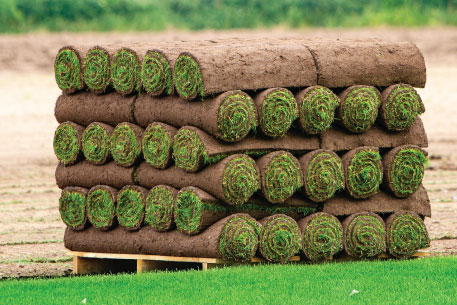
Soil depth is approximately 10mm and the grass sward approximately 30mm.
The beauty of turf is that it can be laid at any time of the year. During spring and summer times your turf will establish quickly, and ground preparation work is more easily carried out. Turf laid during this time will require watering in establishment. Autumn and Winter months are also ideal for laying your turf and the benefits of installing turf at this time of year are that less or no watering is required to establish your turf. Read more about Aftercare.
The recommended time of year would be April to September. Buy seed for over-seeding.
Yes, turf is quite happy growing on clay soils as long as the soil is permeable (i.e. has drainage). Clay soil drainage can be improved by incorporating sharp sand and/or fine grit.